How to read this collection. “Recorded” means a result in the retained development archive, reviewed during the October 2026 research synthesis. It does not mean the experiment was rerun for this website. “Proposed” identifies work still to be done.
These are curated evidence briefs. Source titles identify the underlying records; most technical records are local research materials and are not yet publicly downloadable. The linked essays are public. The interactive rule explainer reconstructs a recorded case; it does not invoke an AI service.
01 · Track I · Experience design + historical implementation
Construct. Practise. Return.
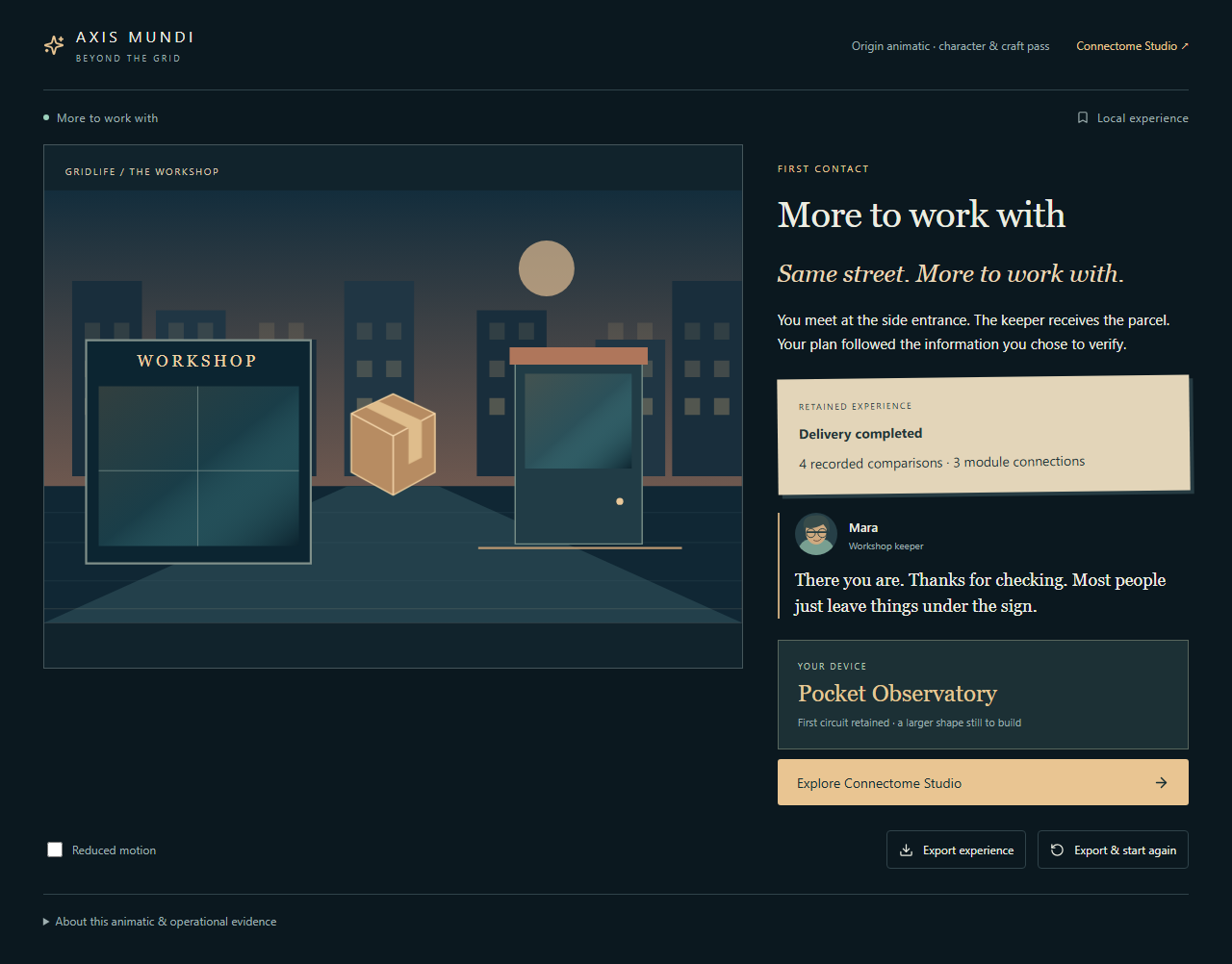
Mara makes a small part of the Axis Mundi proposition tangible: choose a profile, construct an agent, practise with it, then return to situations with choices and consequences.
The larger Human Potential Simulator design joins ordinary life, rupture, discovery, construction, practice and return. The narrative supplies reasons to care about what is learned and carried forward. Mara, from the Origin demonstration, is a smaller implemented episode within this research lineage.
What the retained record shows
A chosen and revisable profile, symbolic construction and a three-Processor comparison.
Practice involving disagreement, changed context and missing support, with optional assistance.
Return decisions and retained consequences. In a separate backend-replacement check, 20 existing events survived and five more were appended.
What this supports—and what remains openA purposeful experience architecture and a bounded implemented loop. The restart used existing receipts, not fresh inference. It does not establish human learning, changed participation in daily life, or completion of the full Axis Mundi journey.
Why it matters
The programme’s unit of inquiry is a continuing person–agent–world trajectory. A correct answer in one encounter is only one possible outcome. Curiosity, attachment, learning, assistance and chosen refusal can each matter differently.
Source record · Local archive
OCA Architectural Demonstration Review — Axis Origin 05: First Release, Phase Report; Axis Mundi game design: Experience, Systems and Simulation. Reviewed in research paths 01 and 02.
Interactive animaticBring a capability back into the world.
The return to Mara carries the chosen device and recorded comparisons into an authored outcome. Construction, inquiry and return become one experience arc.
02 · Tracks I & II · Controlled computational record
What retained procedures changed.
In one engineered sequence of 11 encounters across two localities, retained procedures changed later task performance under bounded action budgets.
Recorded local-learning comparison
Condition
Successful encounters
Interpretation
With retained memory
9 / 11
Five retained procedures available
Without memory
4 / 11
Matched bounded budgets
A larger-budget primitive-only route also succeeded on its supported task. Cold-locality and insufficient-evidence cases failed. Those controls matter: the result concerns reusable procedures and resource limits within this designed sequence.
BoundaryThis is agent-side computation, not an 11-person study. The evidence does not establish general learning, human capability gains or superiority over ordinary procedural reuse. The same record appears in several research paths; it remains one evidence family.
What comes next
Separate agent improvement, joint task success and the person’s understanding. Then examine whether a chosen capability carries into a meaningfully changed context, with continued assistance available when the person wants it.
Source record · Local archive
OCA Simulation — Local Learning Campaign, Phase Report and Result. Reviewed in research paths 01–03.
03 · Track II · Controlled computational record
A rule that could be wrong—and change.
A counterexample involving dependent accounts led to withdrawal of event=same_event and retention of the narrower action rule event=same_event AND origin=independent.
Across the four post-refinement episodes, the revised trajectory matched the benchmark in 4 of 4 cases; a frozen predecessor matched 2 of 4. The actions were inspect or hold: independent same-event cases received inspection; dependent cases were held. Recorded reads were four versus eight. The full developing trajectory matched 7 of 10 episodes.
The historical record includes ten provider observations and two failed attempts due to rate limiting. Two later appended fixtures are separate from the ten-episode comparison.
BoundaryOne finite trajectory within a restricted feature vocabulary. The result shows a retained revision affecting later computation. It does not establish open-ended reasoning, domain transfer, human understanding or a generally safer relationship.
A useful distinction
A separate source-dependency experiment flagged two declared dependent claims after a source changed, left one unrelated control unaffected and retained 30 original records. Flagging a need to reconsider is different from discovering a dependency or revising a rule. Neither mechanism should inherit the other’s claims.
The next discriminating comparison
Use held-out evidence relationships, a frozen predecessor, counterexample-driven revision and a conventional explicitly coded revised rule. Include irrelevant changes, insufficient information and matched action budgets.
Source records · Local archive
OCA Simulation — Developing Pattern Loop, Phase Report and initial Result; ENG18: Evidence Dependency Experiment, Phase Report. Reviewed in research path 03 and the TRUST dossier.
Governed worlds need more than a successful save button. They need an account of what happens after conflict, interruption, retry and return.
RealityOS’s operating-system integration record includes nine bounded journeys, four real DU process stops and 11 event receipts. It covers a real conflict response and a lost acknowledgement after an actual commit: retrying the same operation did not duplicate it. Publishing a second version retained the earlier instance’s version.
The lost-acknowledgement comparison used an automated disk-backed pending-state harness. The separately attributed browser observations covered a narrower journey; this does not establish browser-reload recovery of pending operations.
Three separate continuity cases
System / case
Supported observation
Limit
RealityOS operating journeys
Conflict handling, process restart, exact retry and version retention
Local trusted operator; process restart is not power-loss qualification
Origin / Mara
20 events retained, five appended after backend replacement
Existing receipts; separate profile and backend
Axis Mundi local exploration
DU readback before restoring local game / OCA construction
Same-browser recovery; no qualified server-backed developmental lifecycle
Axis Mundi’s authored connection includes ten locations, ten readable observations and five NPCWorkbench-validated character seeds. Later locations remained locked, and it supplies no live characters. Generated rooms, directed exits and locks do not by themselves complete authored story progression.
BoundaryThese are different implementations with different ownership and qualification. Preserved state does not establish external truth, legitimate authority or meaningful continuity for a person. Success in RealityOS or Mara does not complete Axis Mundi’s stopped durable-lifecycle requirement.
Source records · Local archive
RealityOS OSI-05 Phase Report and OSI-GATE Readiness Review; Axis Origin 05 Phase Report; Axis Mundi DU Exploration Validation, Authored Validation and Hosted OCA Recovery. Reviewed in paths 01, 04 and 07. Browser observations retain their original observer attribution.
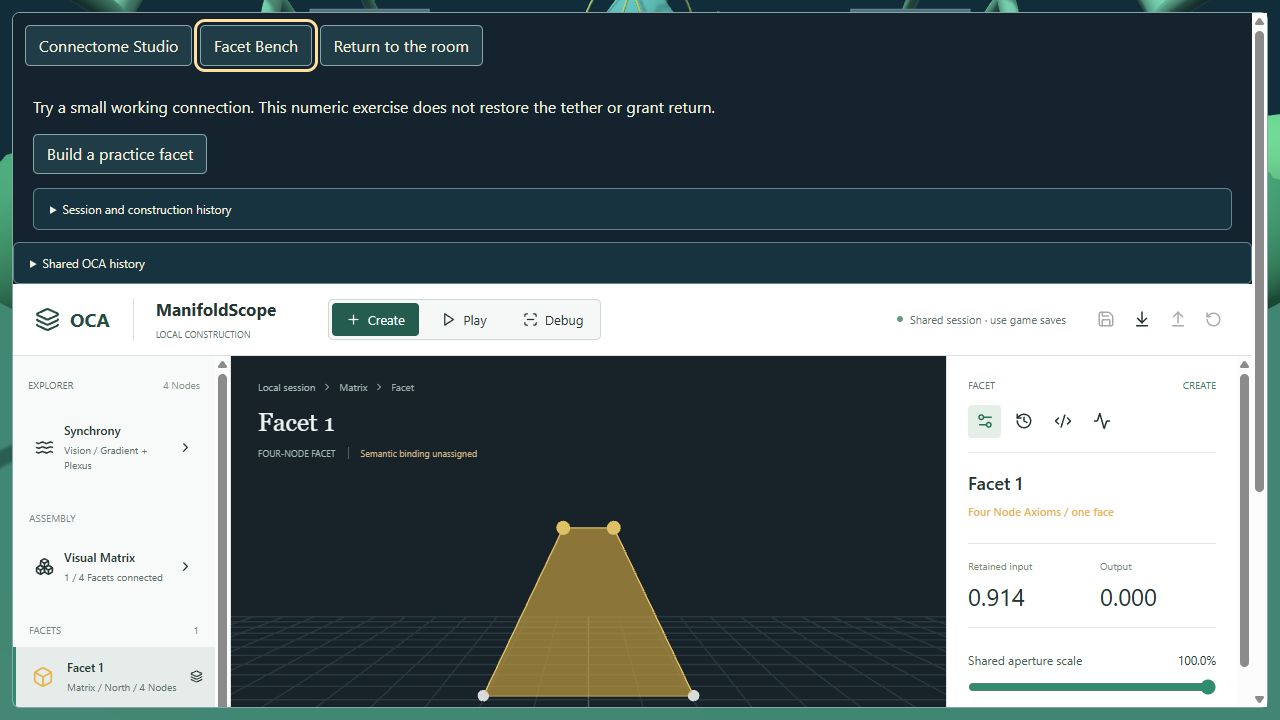
OCA inside Axis Mundi · Restored construction
The hosted Facet Bench after local recovery, 9 October 2026. A separate recorded session from the authored district; it does not demonstrate server durability.
05 · Track II · Architecture + historical view-substitution record
A different view of the same context.
A spatial interface is useful only if it helps someone engage with the work. Technical continuity and human orientation are different requirements.
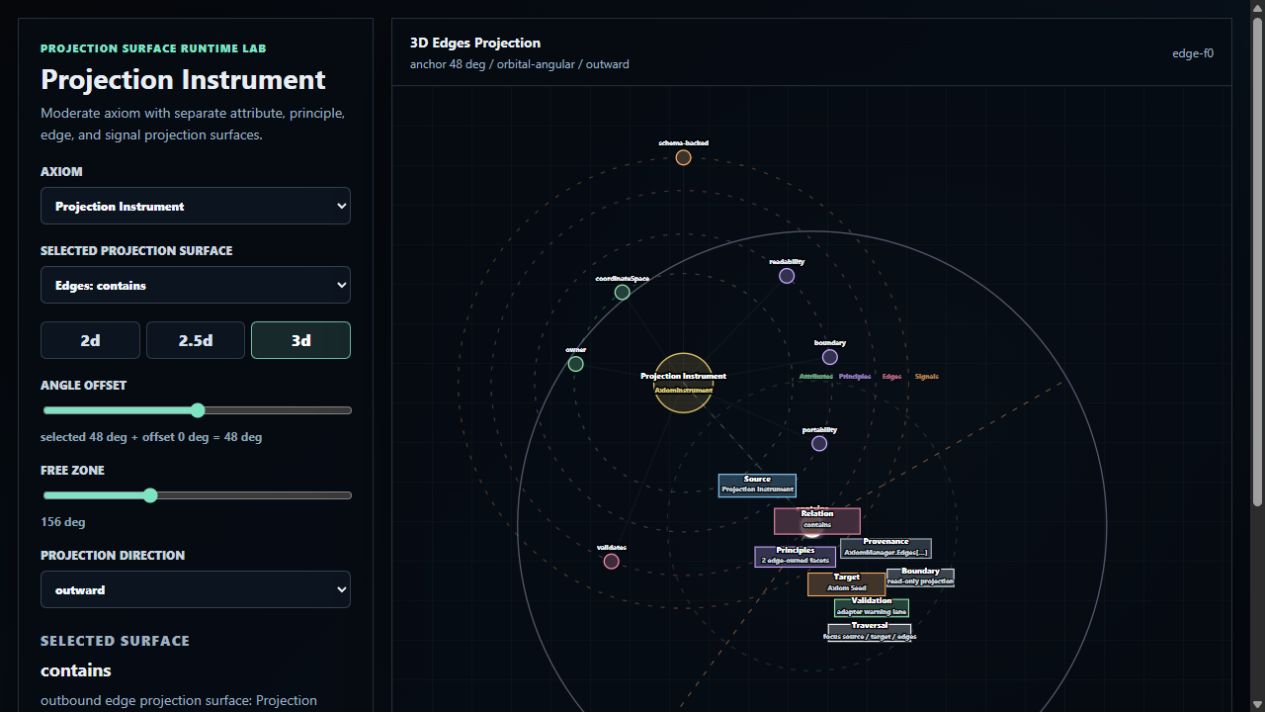
In the retained RealityOS view-substitution case, two internal recipes supported 42 swaps while preserving non-skin state. Swapping views issued no owner requests or draft writes. Later projection work treated layout coordinates as deterministic, configurable presentation data.
The operating grammar keeps reality, studio lens, workbench identity and plane, stance, focus and selection distinct. The conceptual contribution is an environment in which presentation can change without silently becoming world truth.
BoundaryThe swaps are repeated technical operations, not 42 independent usability studies. Dense layouts and overlapping labels remained readability problems. A spatial view is not known to outperform a well-designed list or detail view; generated coordinates are not canonical geometry.
What comes next
Compare spatial and information-matched list/detail interaction, including dense cases, keyboard access and reduced-motion preferences. Evaluate orientation, prediction, correction and effort—not just whether the interface can render.
Source record · Local archive
RealityOS OSI-04 Phase Report and the October 2026 projection architecture evidence. Reviewed in research path 05.
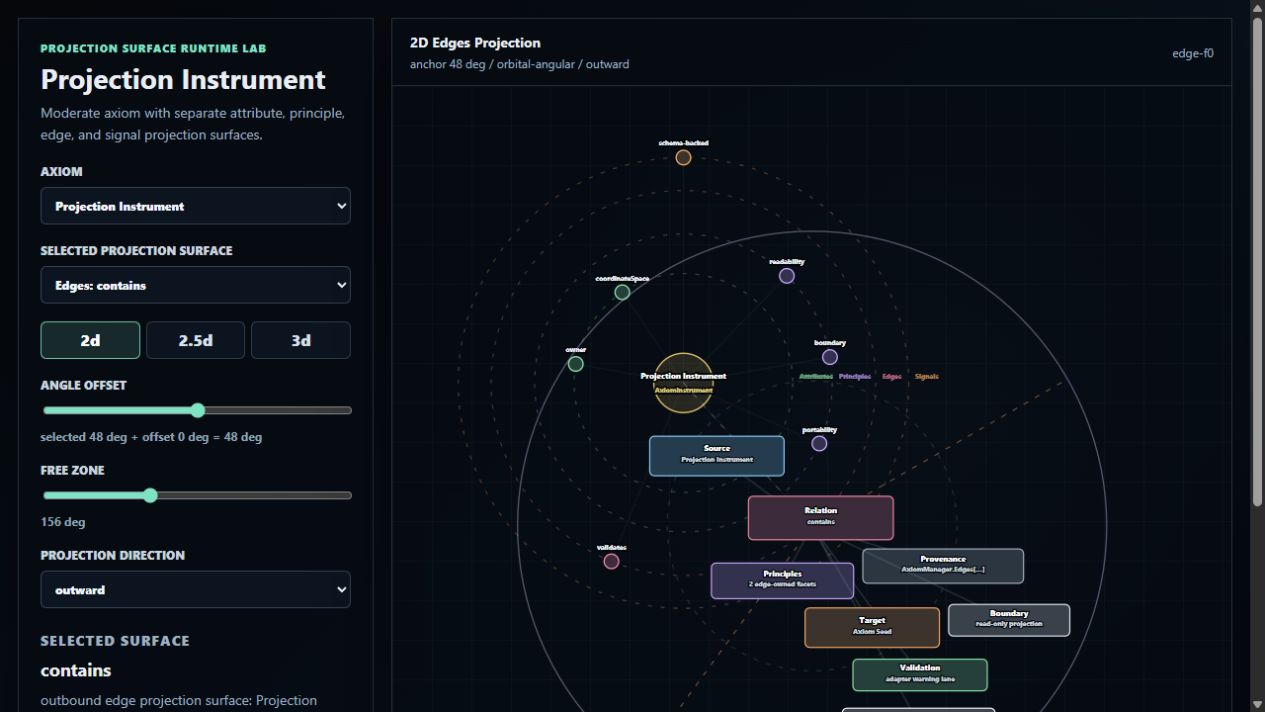
The 2D projection
The same authored relation and its context, arranged in a flat view. Recorded fixture · 15 October 2026.
A continuing relationship needs boundaries that can change. Prior permission should not automatically authorize a later operation in a changed context.
The OCA host-only brokerage exemplar compared admission and decline of the same external offer without changing its content. A pending operation rechecked scope, consent and context. Revocation blocked new operations while the earlier receipt remained.
BoundaryThis is a trusted-host exemplar. It is not a qualified authentication system, a blockchain DAO or proof of data custody. Revoking future operations does not erase prior influence or exported copies.
Connection to transformative TRUST
The relationship question includes who benefits, who can interpret an experience and who can change the terms. More compliance or engagement cannot be assumed to mean a better relationship. Chosen delegation and warranted distrust both belong in the account.
Source record · Local archive
OCA Architecture DAO-02: Host-Only Brokerage Exemplar, Phase Report and Validation Report. Reviewed in research path 02.
07 · Tracks II & III · Negative computational result
More evaluation, no better outcome.
In three repeated semantic-refinement scenarios, the added evaluator produced equal outcomes while reading more.
Recorded read counts with equal outcomes
Scenario
Evaluator path
Ordinary path
1
4 reads
2 reads
2
4 reads
2 reads
3
4 reads
0 reads
The result constrains the design argument: adding a semantic evaluator is not inherently useful. Its cost needs a situation in which the additional examination changes something worth changing.
BoundaryThree bounded scenarios do not show that evaluation is always unnecessary. They establish an equal-outcome, extra-read result in these cases and motivate a more discriminating comparison.
Source record · Local archive
OCA Simulation — Repeated Semantic Refinement, Phase Report. Reviewed in research path 03 and used as a corrective case across the programme.
08 · Track I · Authored conceptual and methods work
Reflection without a human scoreboard.
What would an account of development look like if it helped someone articulate their experience without claiming authority over their worth?
Frequency of Being and the wider qualitative-instrument programme explore representations for reflection. The public anti-gaming argument resists reducing people to scores for ranking, punishment or exclusion. That ambition is valuable as a design proposition; it does not yet establish validity or resistance to misuse.
The wider proposal also considers leadership selection, which creates a tension with its anti-ranking commitments. A narrative, symbol or qualitative category can acquire institutional power just as a number can. Participant correction, alternative interpretations and limits on use belong in the design of the instrument itself.
BoundaryTerms such as Conscious Mass and the atlas’s Conscious Field have conceptual and version-specific meanings in this work. Computational proxies do not validate human consciousness measures. Speculative physical accounts require their own evidence.
What comes next
Compare a factual, revisable narrative with a reflective representation. Study what participants find useful and what they reject. Separately examine a fictional incentive setting to see how the representation might be gamed or repurposed for selection.
Public writing + local source review
Frequency of Being: from anti-gaming, The Metric Economy and retained instrument-version records. Reviewed in research path 06.
Axis Mundi’s durable-lifecycle phase remained unaccepted because the supported owner contract was missing, despite passing surrounding regressions.
The recorded phase reported 13 host, 65 game and four OCA checks passing, alongside a successful build. Those checks could not substitute for the actual lifecycle requirement. Six accepted predecessors remained preserved while the phase stayed stopped.
This case sits beside a different RealityOS handoff that reached its bounded acceptance and then required human review. Proceeding within a limit and stopping at a missing requirement are both relevant research material.
BoundaryThese are purposively selected historical cases. They show reconstructable dispositions, not a measured reduction in defects, safer outcomes or superior agent-team productivity. Later capabilities do not rewrite the historical stop.
What comes next
Define a closed source window, use an explicit sampling rule and ask independent readers to reconstruct authority, contrary evidence and remaining uncertainty. Compare structured provenance with ordinary chronological records containing the same information.
Source records · Local archive
Axis Mundi TD-03 Phase Report, Owner Delta, Validation Report and campaign journal; RealityOS OSI-GATE Readiness Review and campaign journal. Reviewed in research path 07.
10 · Tracks I & III · Source-driven correction
Correcting a compelling representation.
A visually persuasive instrument still needs a clear account of what its variables mean and what makes its display change.
The OCA Lane16 corrective record separated source authority from computational proxies, treated missing Spiritual Energy as unavailable rather than zero, and changed geometry from clock-driven to state-derived. The decision log attributes acceptance of the correction to the Human; the full original conversation was not recovered.
A same-checkpoint comparison remains a signal inside one model. Four focused tests qualified the bounded correction. Neither supplies construct validity for a human instrument.
BoundaryThe correction preserves useful computation while narrowing what the representation can claim. It does not validate field physics, biological consciousness or a quantitative measure of a person.
Source records · Local archive
OCA Lane16 Coupled Dynamics Conformance Gate — Corrective Addendum and decision record D033 → D034. Reviewed in research paths 06 and 07.
Reading the visual language
Where is the AI in the atlas?
The person is the relationship’s human participant. OCA is the modeled agent architecture. Axis Mundi offers an experienced world; RealityOS organizes the operating context and continuity around that engagement.
The artwork’s nested landscapes express this possibility symbolically. They do not map one-to-one onto released software modules, and not every depicted place or capability has been built.
Human Tether
The continuing human–agent relationship represented in the maps. It is a design idea, not a literal physical connection.
Inner Atlas / OCA
A conceptual geography of modeled capacities and relations, including Agency, Cognition, Intellect, Persona, memory, attention and context. Naming a faculty does not demonstrate that its model is equivalent to a human faculty.
QBI, HXG and RGE
The atlas organizes these as bottom-up individuated participation, middle-out lived experience and top-down reality in context. They are the artwork’s architectural vocabulary; this portfolio does not treat the labels as empirical findings.
RGE and the Mothership
The Mothership expresses a place of context, possibility and guidance in the Axis Mundi vision. OCA’s internal RGE Ensemble remains distinct from DU’s reality-generation service.
RealityOS and DU
RealityOS supplies operating surfaces and governed context. DU is a separately owned world-system dependency used in the bounded Axis Mundi compilation and exploration connection.
NPCWorkbench
A separate character-tool owner. Validated character seeds in the current Axis Mundi connection are briefs, not live NPCs or dialogue.
Peter Cameron provides the authored concepts and research direction. Development, source review, drafting and synthesis have been assisted by ChatGPT / Codex. DU and shared AMIA components retain their separate development-team ownership; NPCWorkbench and other dependencies retain their own contributions. The broader portfolio presents world-building, human-capability design and Reality Generation alongside this research. It makes no claim of sole authorship over the team’s systems. See the wider platform and development approach.
The October 2026 synthesis reviewed three separate project studies within the same human–AI collaboration and organized seven research paths into three tracks. The internal register contains 70 typed claims spanning authored concepts, designs, historical observations, interpretations and proposed studies. They are not 70 experiments. Shared evidence used across tracks is not a replication.
The original project studies, retained reports and source registers underpin these briefs. This is a curated selection rather than a complete historical census, independent scientific review or proof of broad novelty. Earlier development records and some evaluator/model-selection and loss-landscape work remain discovery leads.
Access to evidence
The website includes selected captioned prototype screenshots, supplied atlas artwork, public-writing links, original editorial summaries and a deterministic explanatory reconstruction. It does not distribute the underlying private repositories, participant data, runtime services or a playable build. Public technical artifacts and any third-party redistribution notices remain release-preparation work.
Research context
The programme is informed by existing work on intelligence augmentation, research through design, transfer and reflective design. These are relevant antecedents, not external validation of the projects.
 RealityOS
 AMIA
 OCA