What the system can do.
Reusable implementations and owner contracts supply generation, storage, rendering, computation and domain operations.
The development approach · The team’s infrastructure
Reality Generation explores a new software-development paradigm: authored intent becomes structured environments, reusable capabilities and experiences that can be created, inhabited and changed.
A game world is one expression. A learning environment, a simulation or an operational workflow can also be understood through people, roles, rules, state, actions and consequences.
The shift in perspective
The central idea is to carry intent and relationships into the running system. A shared foundation can support authoring tools, participant experiences, agent context and diagnostic views.
Reusable implementations and owner contracts supply generation, storage, rendering, computation and domain operations.
Definitions hold reusable structure, purpose, constraints and choices. A new experience can inherit capabilities while keeping its own meaning.
Concrete identities, participants, state and consequences belong to a particular reality and its supported lifecycle.
This is an architectural proposition supported by bounded implementations. It does not claim that arbitrary software, complete games or meaningful human experiences can already be generated automatically.
From intent to experience
Experience, roles, narrative, rules and creative constraints.
Typed templates, world graphs, relationships and validation.
World plans, media assets, character seeds and configurations.
Human selection, qualified capabilities and product integration.
Create, participate and inspect through appropriate surfaces.
Retain supported state, examine consequences and revise.
The platform gives this loop reusable machinery. Product authors and participants give it purpose. Its current evidence consists of specific connected examples and separate owner capabilities, with further integration still needed.
World systems · DU / Reality Generation Engine
DU supplies reusable domain models and world-generation capabilities behind the broader AMIA direction.
Its author templates carry fields such as premise, genre, tone, player role, canon locks and flexible zones. Deterministic builders turn supported inputs into plans involving regions, rooms, connections, quests, factions and constraints. Axiom-based models, graph adapters and retrieval support the surrounding domain system.
The result has a lifecycle: a plan, a candidate, an admitted published version and a running instance are different things. Keeping them distinct lets teams experiment without silently replacing the accepted world.
NPCWorkbench and its DU backend provide character-authoring, validation, preview, commit, readiness and engagement contracts. OCA supplies a separate architecture for modeled agency. Bringing both into a product requires explicit identity, context and lifecycle bindings.
Concrete exampleAxis Mundi connects authored material to real DU candidate compilation and admitted local exploration. Its content handoff contains ten locations, ten observations and five validated character seeds. Later locations remain locked; no live cast or complete server-backed game lifecycle is established by that connection.
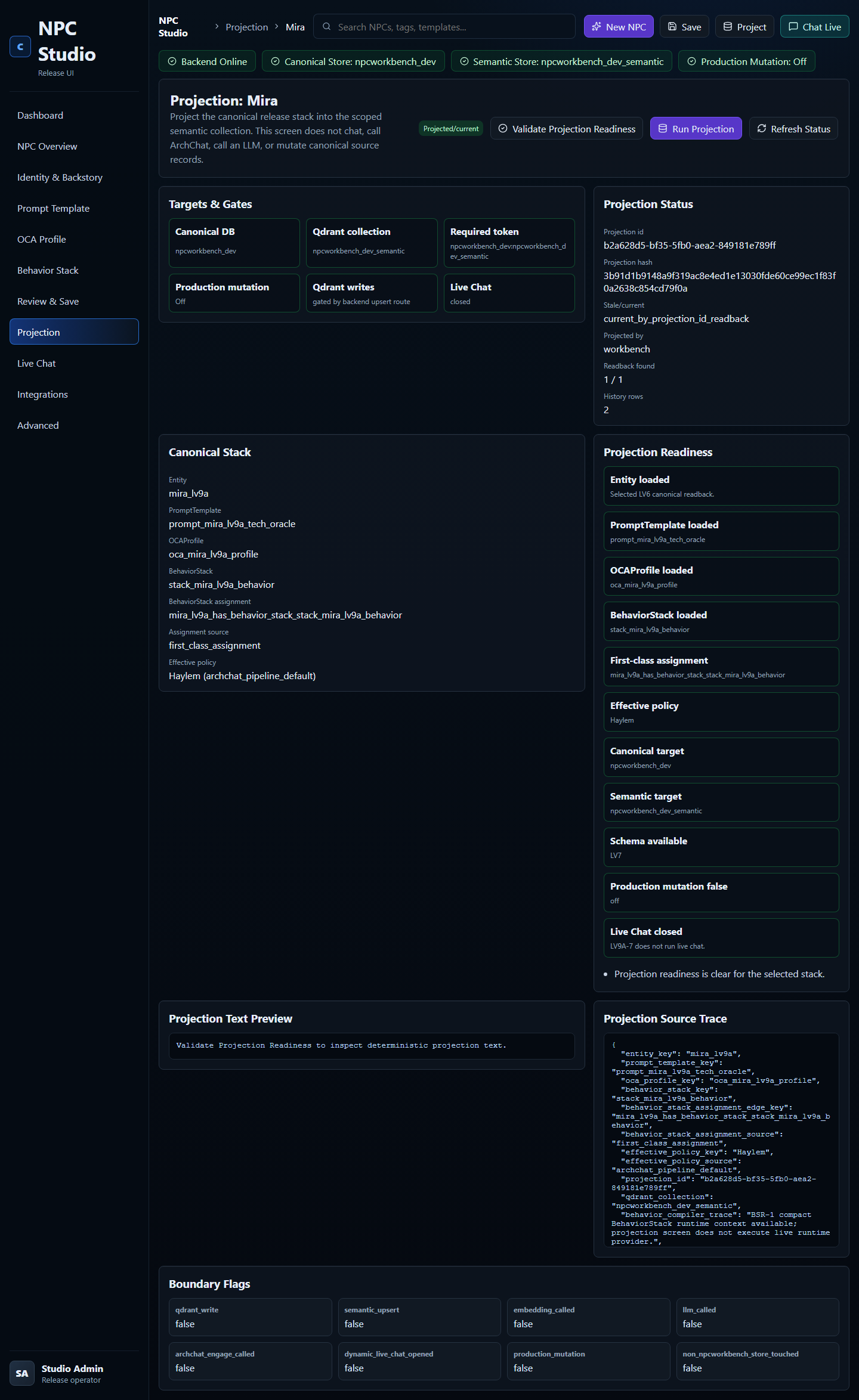
NPC Studio brings identity, prompt, OCAProfile, behavior and policy into a traced semantic projection. This is a historical development capture; the full-page image can be scrolled.
Open full capture ↗Production services · SGAP / AICS / ASH
A generated world needs an asset pipeline, execution resources and a reliable way to deliver their results into an experience.
The Sovereign Generative Asset Platform (SGAP) supplies managed requests and jobs, candidate artifacts, identifiers, provenance, integrity checks, review packages and delivery contracts. ComfyUI is an execution backend within that service boundary. Product teams still own creative direction, candidate selection and integration.
Job fanout, duplicate suppression, retries and resume support repeated production work. A deterministic diagram capability sits alongside generative-media workflows. The reviewed standalone architecture retains DU as the production-node owner pending consumer migration; it should not be presented as a completed cutover for every product.
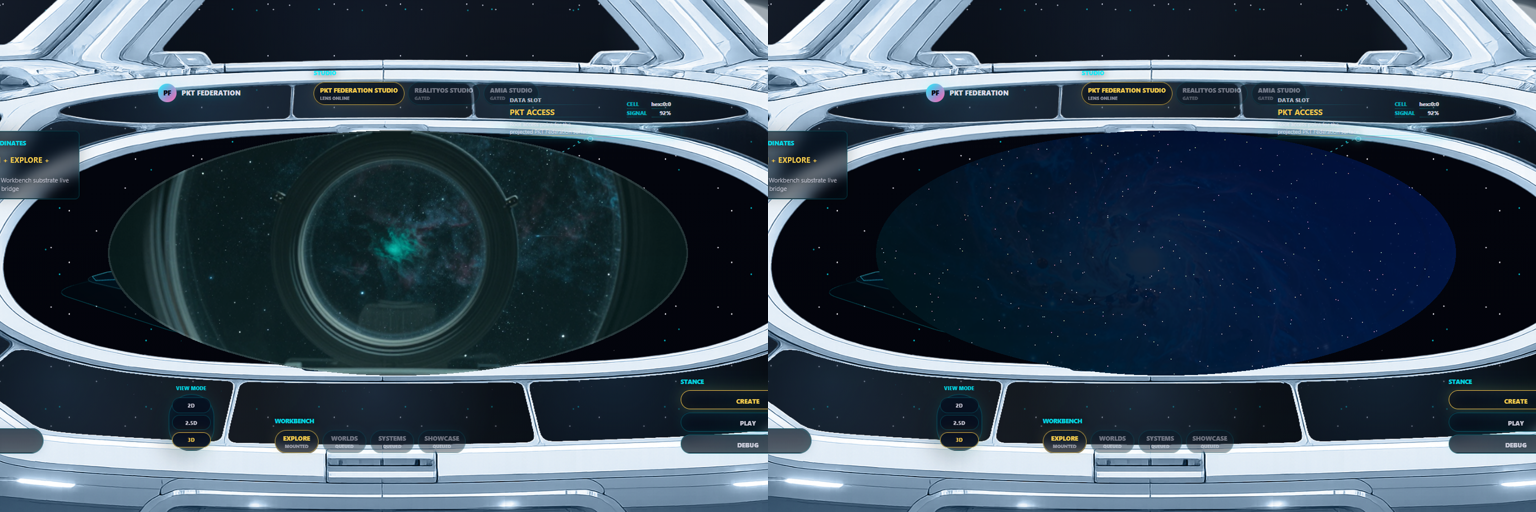
An accepted reference and a recorded live-generation result are compared inside the same controlled W17 surface. The PKT cockpit is a production fixture used to qualify a bounded asset path.
Open full capture ↗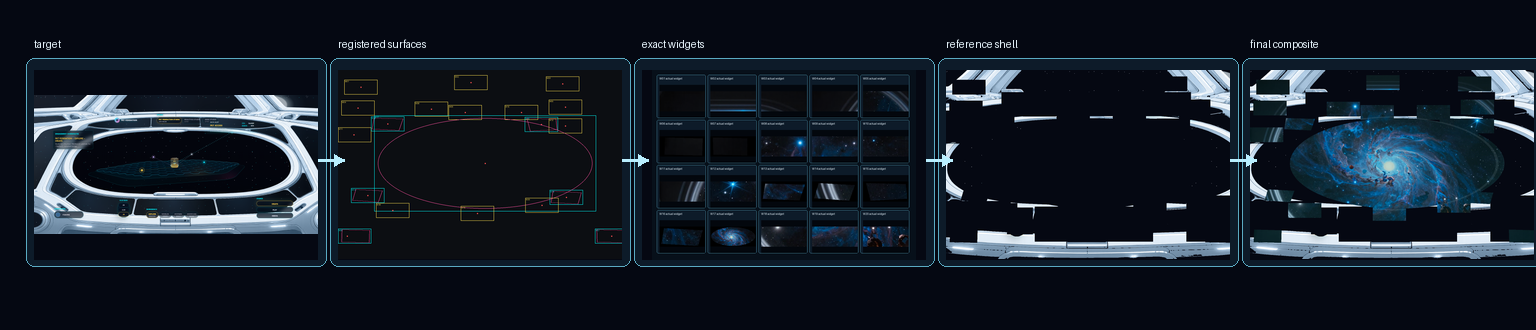
Target, registered surfaces, individual widgets, shell and assembly are brought together in an existing review strip. The intermediate composite exposes the work still under review.
Open full capture ↗AICS supplies compute qualification, placement, access, leases, release and accounting. ASH is its separate service-hosting family. These capabilities support domain owners while leaving prompts, interpretation, world meaning and product acceptance with the relevant systems.
What is connected todayCurrent Axis Mundi generated exploration does not require model inference. SGAP asset production and further compute-backed engagement remain separate capabilities or future product joins. A service contract alone does not establish a deployed, complete content-production pipeline.
SGAP standalone architecture; AICS service and hosting documentation; DU Game Factory and development-pipeline documentation. The source-to-owner mapping is retained in the portfolio’s editorial provenance.
The machinery for building the machinery
Reality Generation depends on how the team develops, validates and maintains capabilities—not only on what appears inside a finished experience.
These owners give the collaboration common ways to carry intent, work and evidence across projects. A successful worker result, a released compute lease and product acceptance still mean different things.
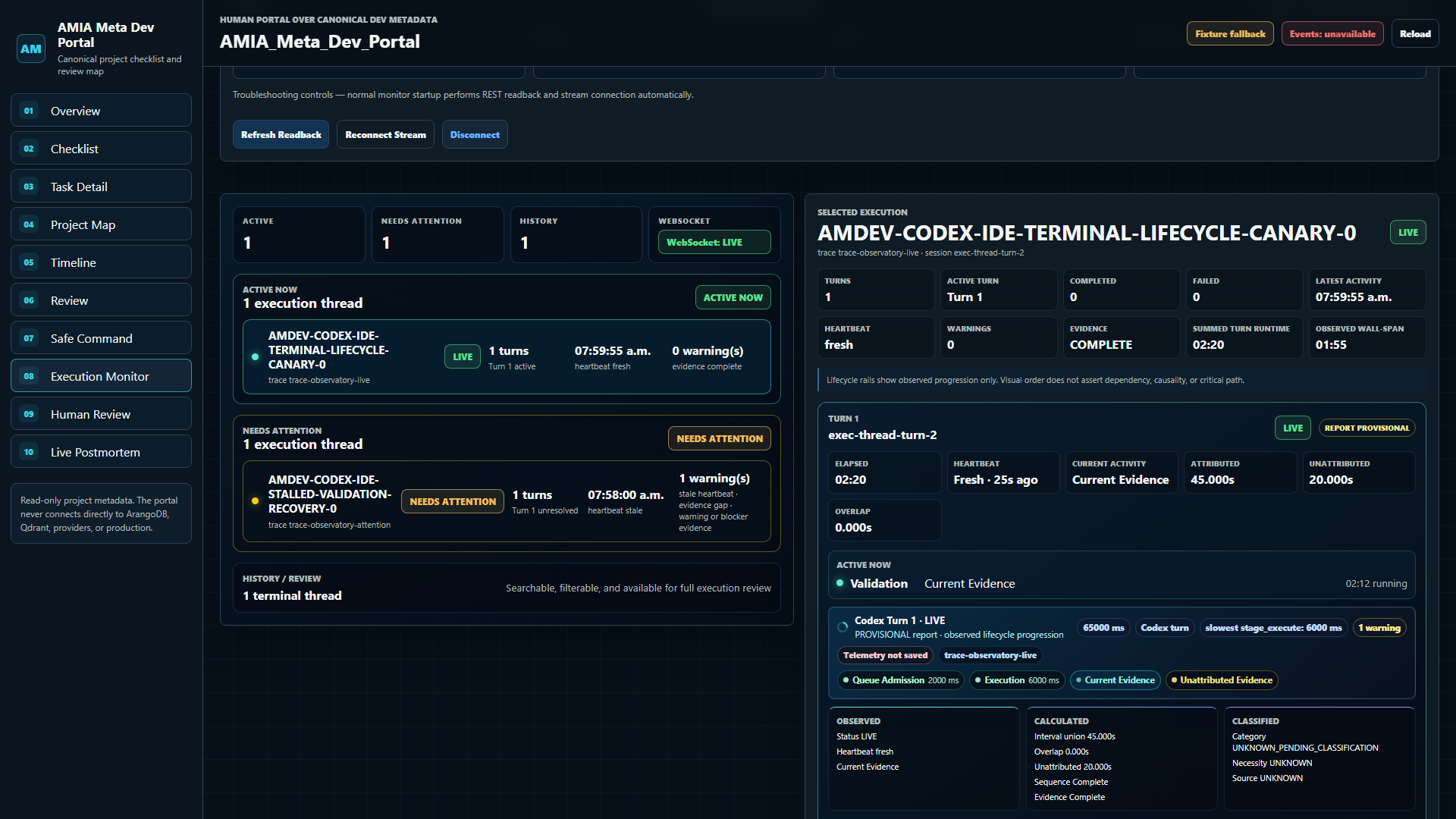
The Meta Dev Portal groups active, interrupted and historical execution with attribution and evidence. This built interface was captured against deterministic qualification fixtures.
Open full capture ↗Purpose · Operating environment · Agency
Axis Mundi, RealityOS and OCA are connected expressions of this larger practice.
Their unity lies in purpose and composition. Their ownership, maturity and evidence remain specific. OCA’s RGE Ensemble is part of the agent architecture; DU’s Reality Generation Engine supplies separate world machinery.
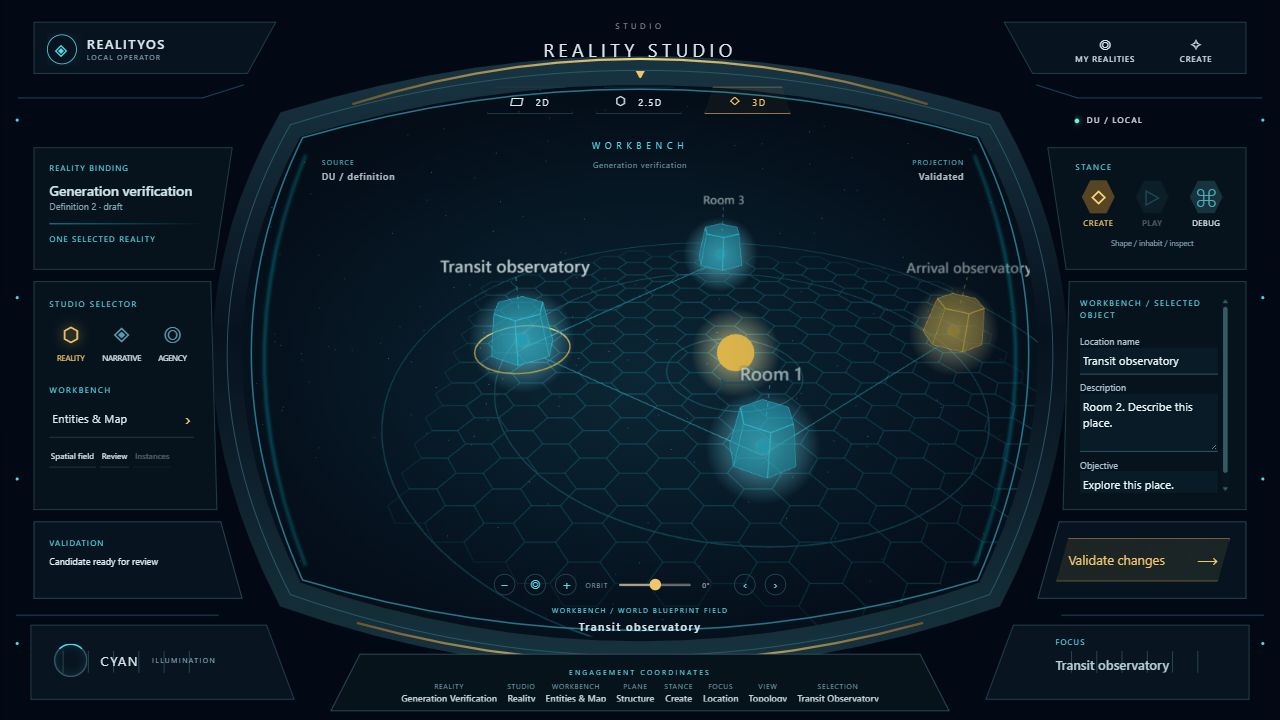
Reality Studio brings DU-backed locations, selection and editable place descriptions into a 3D workbench. This recorded integration connects the operating instrument to an actual world definition.
Open full capture ↗Why the infrastructure matters
The efficiency proposition is concrete: reduce the amount of infrastructure each new experience must reconstruct, and make iteration easier to reproduce and inspect.
| Mechanism | Repeated work it aims to reduce |
|---|---|
| Existing-owner discovery | Rebuilding known foundations or rediscovering resolved integration problems |
| Templates and deterministic builders | Reimplementing world-generation logic for every supported definition |
| Shared asset contracts | Recreating job handling, provenance, retry and artifact delivery |
| Qualified compute and hosting | Rebuilding resource-readiness and lifecycle machinery in each product |
| Execution profiles and evidence bundles | Reinventing task setup, bounded validation and result handoff |
| Multiple operating surfaces | Coupling a domain model permanently to one presentation |
Efficiency claimThe reviewed work supports these reusable mechanisms and bounded demonstrations. It does not yet supply a measured development-speed multiplier, general cost reduction or automatic full-game generation. A fair comparison would track equivalent scope, quality, integration effort and human review time.
Public team demonstrations
PKT Federation’s public showcases connect structured world creation with the production systems around it.
The team’s showcase page describes the conversion of bounded authored adventure material into world structure and navigable presentation. The current public entry page identifies itself as a local character-entry and handoff shell; it explicitly limits the current run before movement, inventory or combat. It is a useful point of entry into the direction, with narrower current behaviour than a full-playthrough claim.
The team presents a bounded arcade production case: reusable runtime modules, alternative execution backends, asset governance and release artifacts. The showcase is relevant because the production process is part of the platform proposition. The public entry rendered a game-selection interface listing seven options during this review. No gameplay run was started, and the historical production claims on the showcase page were not rerun or independently qualified for this portfolio.
External demonstrations are operated by the team and may change. No new character, saved run or provider-backed operation was initiated during this review.
Sources & contribution
My contribution is the connection between human capability, learning architecture, world-building, operating models and practical product development. AMIA/DU and the supporting platform are collaborative engineering work; this portfolio does not assign every subsystem to me.
This account draws on the PKT Federation website, my supplied positioning package and résumés, and selected owner documentation and source contracts. The public site establishes the team’s stated direction. Local technical evidence shows specific mechanisms and their limits. A bounded source review is not an audit of the complete ecosystem or a fresh deployment qualification.
Research belongs inside this practice: it examines what these systems make possible, where they fail, how people experience them and what should change. The three-track programme and selected evidence briefs remain available in full.
Powered by
The connected explorer runs on RealityOS. AMIA supplies the wider platform context; OCA is presented through recorded demonstrations in this edition.
 RealityOS
 AMIA
 OCA