Give a world working form.
DU supplies models, generation and domain operations. NPCWorkbench supplies character-authoring and engagement contracts. Creative intent gains a structure that can be inspected and tested.
World and agent foundations →Immersive worlds · Human capability · Reality Generation
Advancing human possibility—while keeping people authors of their own lives.
I am an educator with years in immersive learning and four years developing Operational Conscious Agency. My work investigates human potential, trust, safety, sovereignty and intelligence amplification: a human-centred, non-transhuman path through learning, experience and relationship.
Peter Cameron Selected work · October 2026
The through-line
A world can be a place to explore. It can also be a way to learn, rehearse a decision, work with others, build a tool or discover a possibility you could not yet name.
My work connects those experiences to the systems that make them usable. Across education, enterprise learning, immersive platforms and operational workflows, the recurring task is to turn complex possibilities into roles, rules, tools, interfaces and learning pathways people can actually use.
That practice now extends into Reality Generation: an approach to software development in which authored intent becomes a structured, evolving environment. Within the AMIA collaboration, I connect world-building and human-capability design to the team’s growing development and runtime infrastructure.
Reality Generation · A development paradigm
Begin with what people should be able to experience and do. Model its relationships and constraints. Compose the capabilities that let that reality be created, inhabited, inspected and changed.
Purpose, people, stories, possibilities and intended experience.
Roles, places, rules, relationships and reusable templates.
World structure, assets, agent configurations and supported services.
Surfaces for participation, authoring, practice and inspection.
Consequences, feedback, retained state and deliberate revision.
The proposition is broader than generating content: a reusable world model can inform an experience, its authoring tools and its operating rules. Concrete pieces work today; their complete composition remains an active development programme.
See the platform and pipeline ↗Built with a team
AMIA is the wider collaboration and capability ecosystem. DU’s Reality Generation Engine is a central world-system foundation. Shared infrastructure lets each product build on work that already exists.
DU supplies models, generation and domain operations. NPCWorkbench supplies character-authoring and engagement contracts. Creative intent gains a structure that can be inspected and tested.
World and agent foundations →SGAP manages asset jobs, artifacts and review. AICS supplies qualified compute and a separate service-hosting capability. Products retain creative selection and integration.
Production services →Core discovery, SACF execution, Trinity contracts and the Meta Dev Portal support structured work, validation and review across projects.
Development infrastructure →These are team-owned capabilities with distinct responsibilities and qualification boundaries. Reuse and repeatability are concrete design mechanisms; a measured end-to-end productivity multiplier has not been established.
Three connected expressions
A Human Potential Simulator combining adventure, construction, practice and return. Beyond the Grid is a narrative episode in a continuing world, giving human–AI development a meaningful setting.
Experience design & implemented slices →Studios, workbenches, stances and projections for creating, participating and inspecting. The same selected Reality can be approached through different concerns and useful views.
Operating context & view evidence →Configurable, inspectable agency: construction, access, interpretation and bounded adaptation mechanisms. It explores how an AI relationship can be understood and shaped over time.
Construction & adaptation evidence →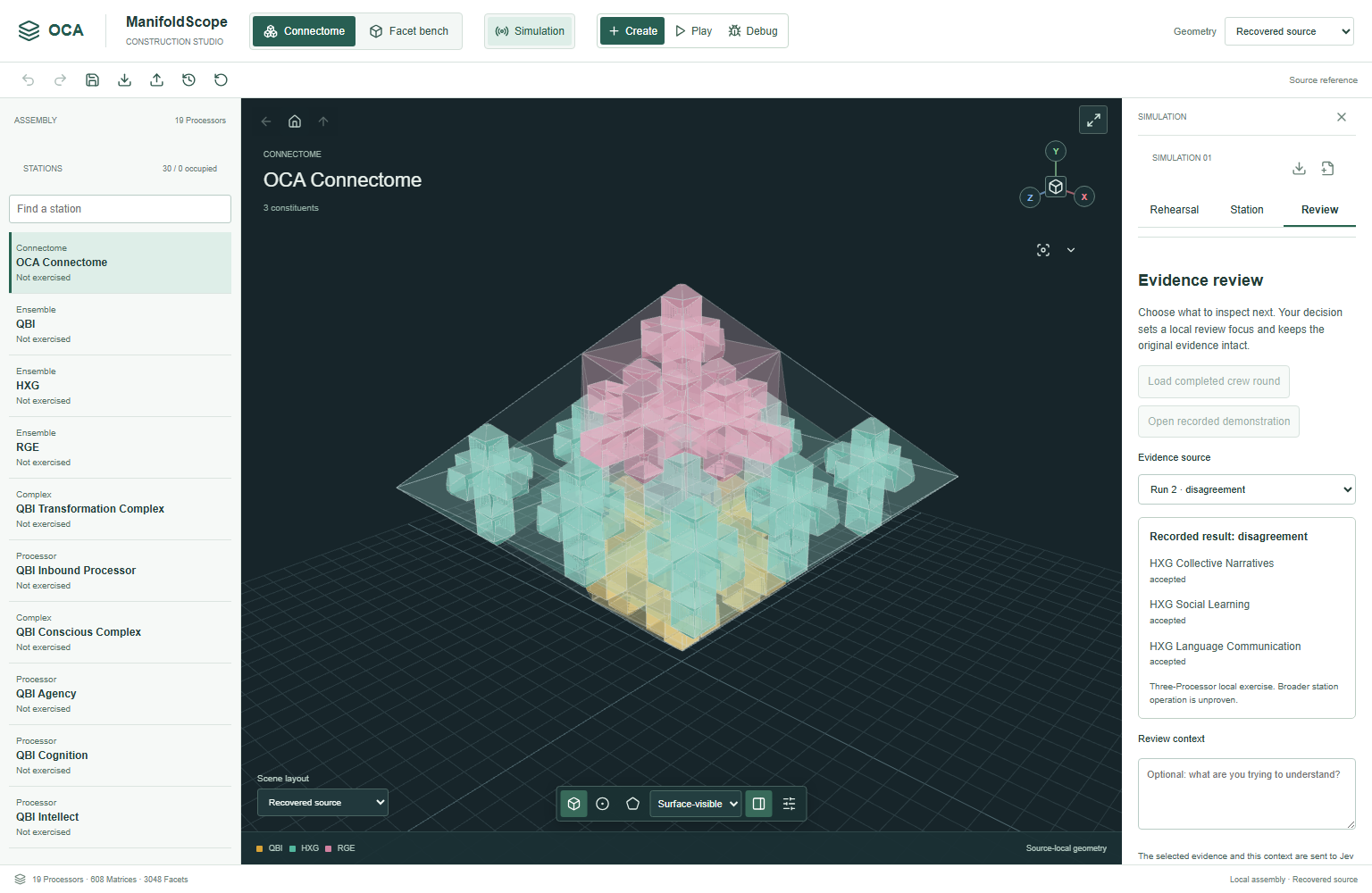
OCA / Connectome Studio
Reusable assemblies, aperture editing, visible execution, contextual inspection and semantic bindings. Explore the Studio as a working instrument with several capabilities.
Recorded working prototypeExplore this work →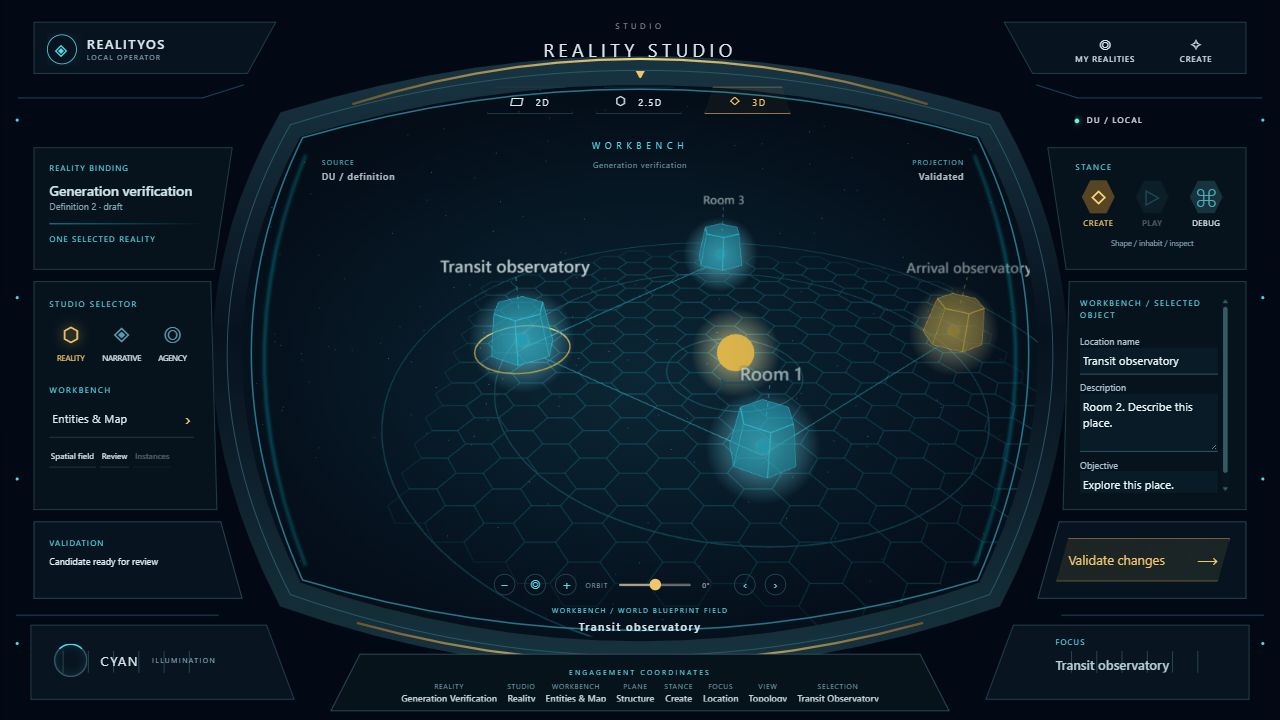
RealityOS / An operating environment
Spatial authoring, encounters, Axiom anatomy, saved instances and a constellation of worlds. Follow the prototype families that make this operating approach tangible.
Recorded owner integrationExplore this work →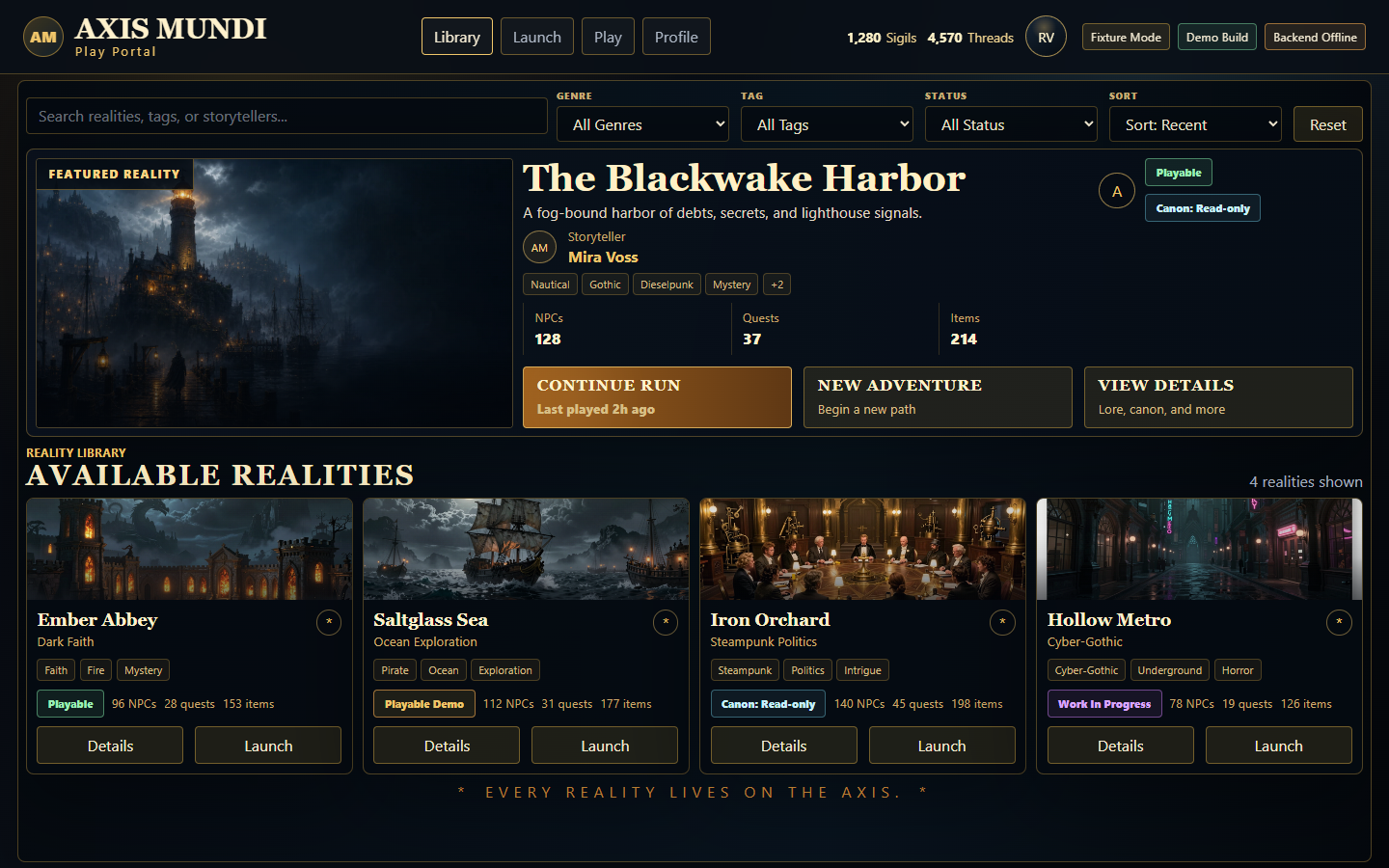
Axis Mundi / The wider experience
The team’s PlayPortal brings world imagery, discovery and entry into a usable interface. Follow it into situated interaction, then explore Axis Mundi’s construction-and-return story.
Implemented UI · fixture captureExplore this work →Axis Mundi supplies the creative purpose and experience; RealityOS supplies operating context; OCA supplies its distinct agent architecture. They draw on the larger platform without replacing its owners. The complete connected experience remains in development.
Read the world · Locate the AI
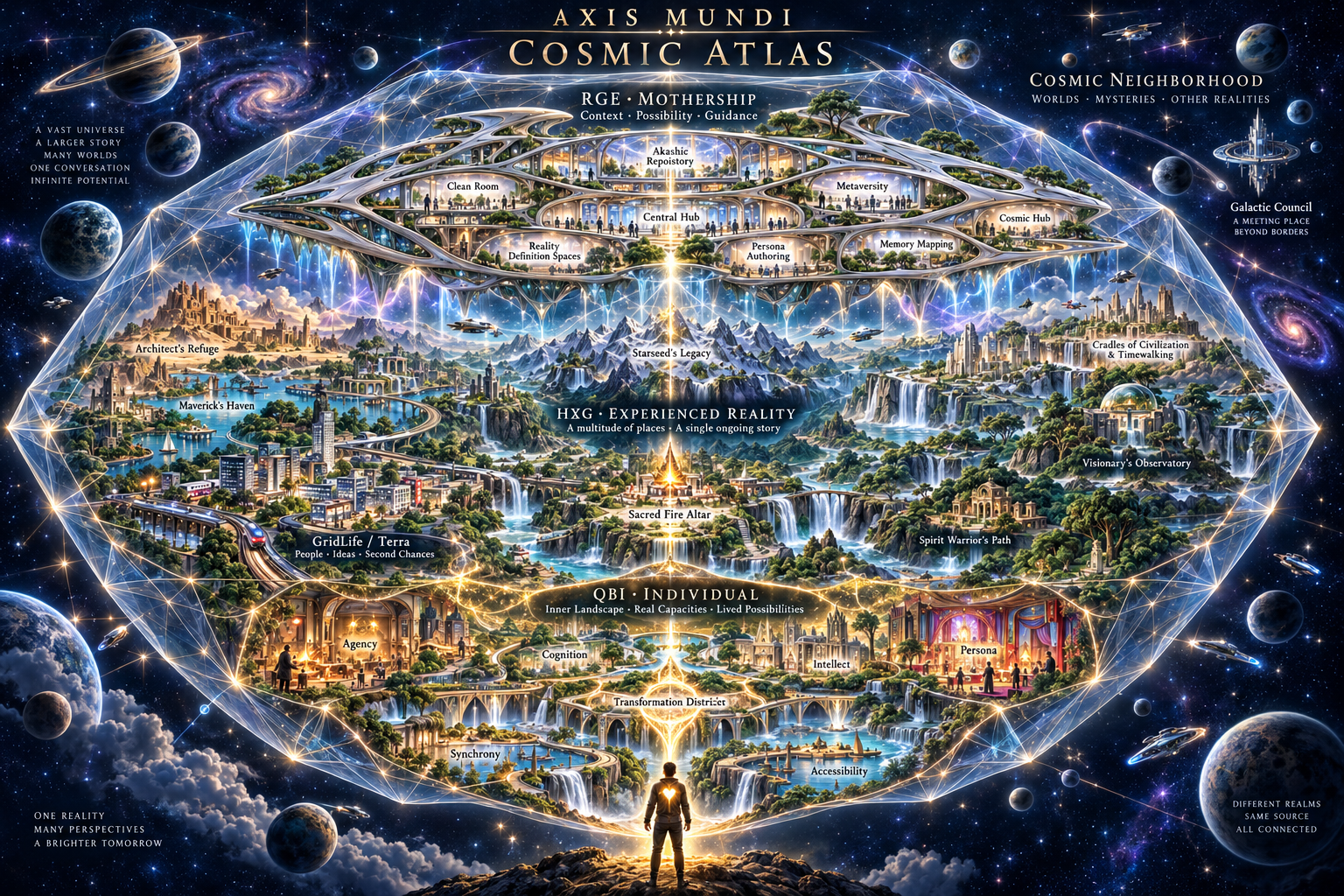
The maps hold the imaginative scope: an inner landscape, a world of lived experience and a wider field of possibility. My world-building connects that landscape to human capability: experiences to inhabit, agents to shape, tools to create with and systems that can carry the journey forward.
The whole proposition: a continuing relationship between an individual, an experienced world and wider possibilities. OCA provides the agent architecture; RealityOS provides operating context; Axis Mundi gives the journey a world.
Chooses purposes, assistance and the terms of participation.
A modeled agent whose construction and selected changes can be examined.
Axis Mundi supplies situations; RealityOS organizes context and continuity.
These are symbolic maps and design propositions. Their geography and terms such as “Conscious Field” are not measurements of human consciousness. The Inner Atlas’s RGE is an OCA ensemble; DU’s reality-generation service is a separate world-system dependency. Read the map’s vocabulary →
Research within the practice
Research gives the work a way to question its own assumptions. It connects the vision to observed mechanisms, human questions, negative results and the next useful comparison.
Meaningful experience, practical authority and humane evaluation.
↗II / Mechanisms & worldsAccess, revision, governed context and ways of engaging.
↗III / Evidence & methodHow evidence changes what we claim, build and do next.
↗About the practice
I work across learning, world-building, product strategy and systems architecture.
My contribution is connecting human purpose with usable structure: helping a team see what a system could become, making it concrete, and designing the pathways through which people can learn and operate within it.
That can take the form of an immersive world, a human–AI workflow, a capability-development experience, an authoring tool or an operating model. Research, prototyping, facilitation and implementation support each contribute to the work.
Explore the PKT Federation collaboration ↗Worlds · Tools · Human possibility
For teams exploring immersive learning, human–AI work, new products and new operating realities.
Powered by
The connected explorer runs on RealityOS. AMIA supplies the wider platform context; OCA is presented through recorded demonstrations in this edition.
 RealityOS
 AMIA
 OCA