Axis Mundi
A Human Potential Simulator: an inhabitable world for discovery, construction, practice and return. Beyond the Grid is a narrative episode within it.
Research within the practice · Human–AI development
How can people and AI develop capabilities together—while people retain authority over the relationship?
One part of a wider practice in Reality Generation, world-building and human-capability design. These tracks investigate its mechanisms, experiences and consequences.
Part of the wider portfolio ←
Sovereign human–AI development Portfolio · October 2026
The question that connects it all
An AI can become more useful while a person becomes less able to question it. A simulated world can offer new possibilities while quietly deciding what counts as progress.
My research begins with that tension. I explore how meaningful, continuing experience can expand what people understand and can do, while keeping assistance, interpretation and change open to human direction.
The programme explores sovereign human–AI development. Sovereignty here means practical authority: choosing a purpose, deciding when to delegate, challenging an interpretation, revising the relationship or leaving it. Learning matters; so do curiosity, enjoyment, appropriate assistance and the freedom to take another path.
Three projects · One connected inquiry
A Human Potential Simulator: an inhabitable world for discovery, construction, practice and return. Beyond the Grid is a narrative episode within it.
Operating environments for governed worlds: keeping context, identity and consequential state intelligible across different ways of engaging.
An architecture for inspectable, configurable and revisable agents: exposing selected structures of access, interpretation, learning and action.
Together, these projects propose a continuing person–agent–world relationship. Their individual implementations have different scopes; the complete developmental experience remains in progress.
Read the world · Locate the AI
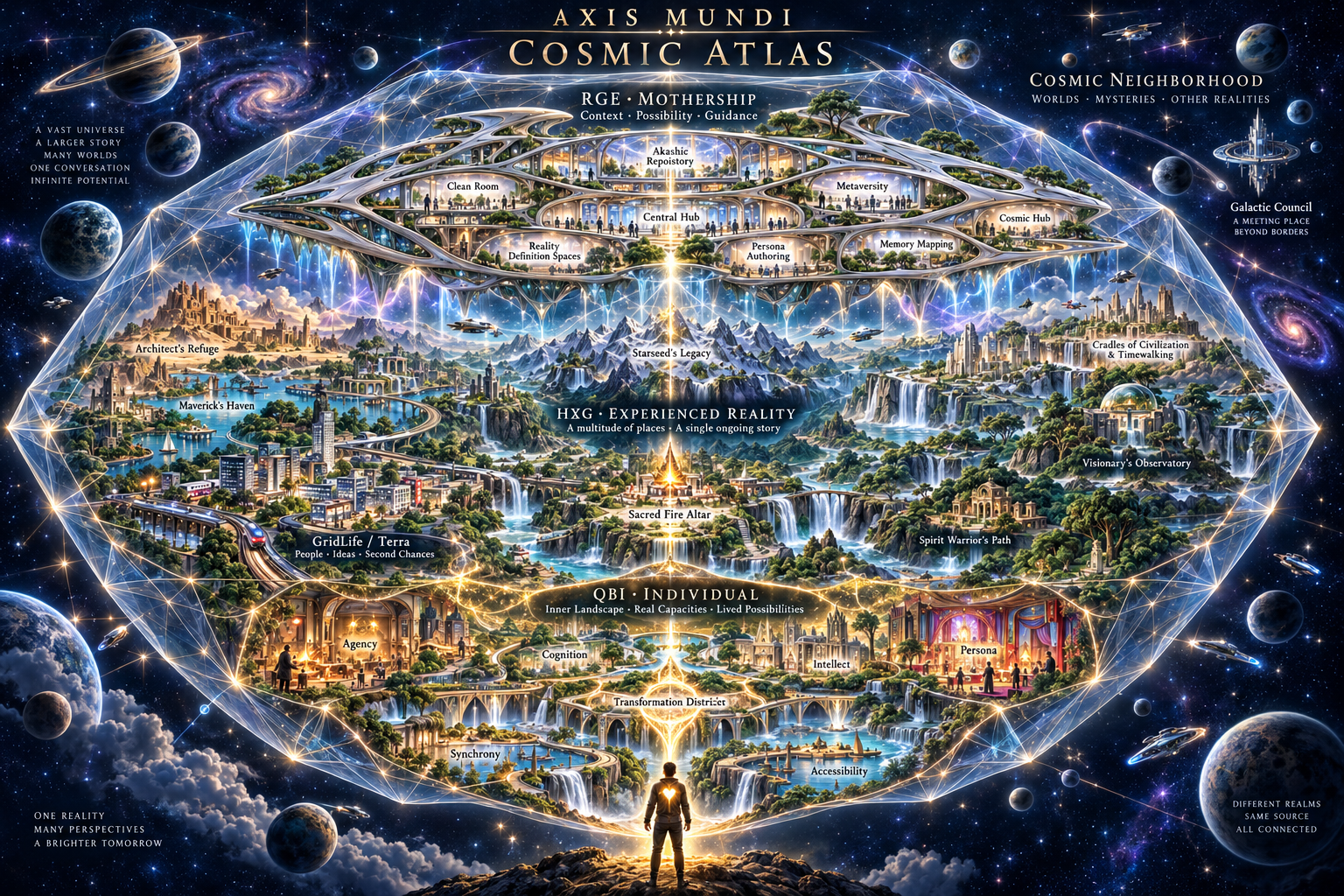
The maps hold the imaginative scope: an inner landscape, a world of lived experience and a wider field of possibility. The research asks how a person and an AI might participate in that landscape together.
The whole proposition: a continuing relationship between an individual, an experienced world and wider possibilities. OCA provides the agent architecture; RealityOS provides operating context; Axis Mundi gives the journey a world.
Chooses purposes, assistance and the terms of participation.
A modeled agent whose construction and selected changes can be examined.
Axis Mundi supplies situations; RealityOS organizes context and continuity.
These are symbolic maps and design propositions. Their geography and terms such as “Conscious Field” are not measurements of human consciousness. The Inner Atlas’s RGE is an OCA ensemble; DU’s reality-generation service is a separate world-system dependency. Read the map’s vocabulary →
The programme
The tracks connect the purpose of the work, the mechanisms that make it inspectable, and the practice through which its claims are questioned.
Purpose & relationship
What changes through shared experience—and who gets to decide whether that change is valuable?
Axis Mundi treats adventure, construction, practice and return as parts of a developmental experience. Transformative TRUST asks whether the relationship expands a person’s possibilities on terms they can choose. Humane evaluation asks how reflection can support that inquiry without becoming a ranking of people.
Open question Does a meaningful experience change what people can understand or do in a different context? Agent adaptation alone cannot answer this.
Mechanisms & environments
Can access, interpretation and consequential change be made understandable enough to question and revise?
OCA exposes selected structures of agent computation. RealityOS examines governed context, continuity and alternative views. Axis Mundi brings these questions into an inhabitable setting. Revision has several meanings here: changing a rule, flagging a dependent claim, revoking an operation or reopening a world.
Open question When does exposing a mechanism improve understanding—and when does it add effort or false confidence?
Evidence & method
How can human-directed, AI-assisted research retain its purpose while allowing evidence to change the plan?
The research process is itself an object of study. Development records let us reconstruct cases where work proceeded, stopped or was corrected. A useful result can be a boundary that held, a proxy that was relabelled or an ambitious interpretation that had to narrow.
Open question Do structured records help an independent reader reconstruct authority and unresolved claims better than ordinary development logs?
An instrument for the inquiry
The learning workspace makes one comparison tangible: what can a retained procedure change in a later, bounded task?
The captured workspace shows eight encounters and four retained procedures. The linked research case documents a separate eleven-encounter sequence; the rule-refinement explainer below is another distinct record.
Read the broader learning evidence →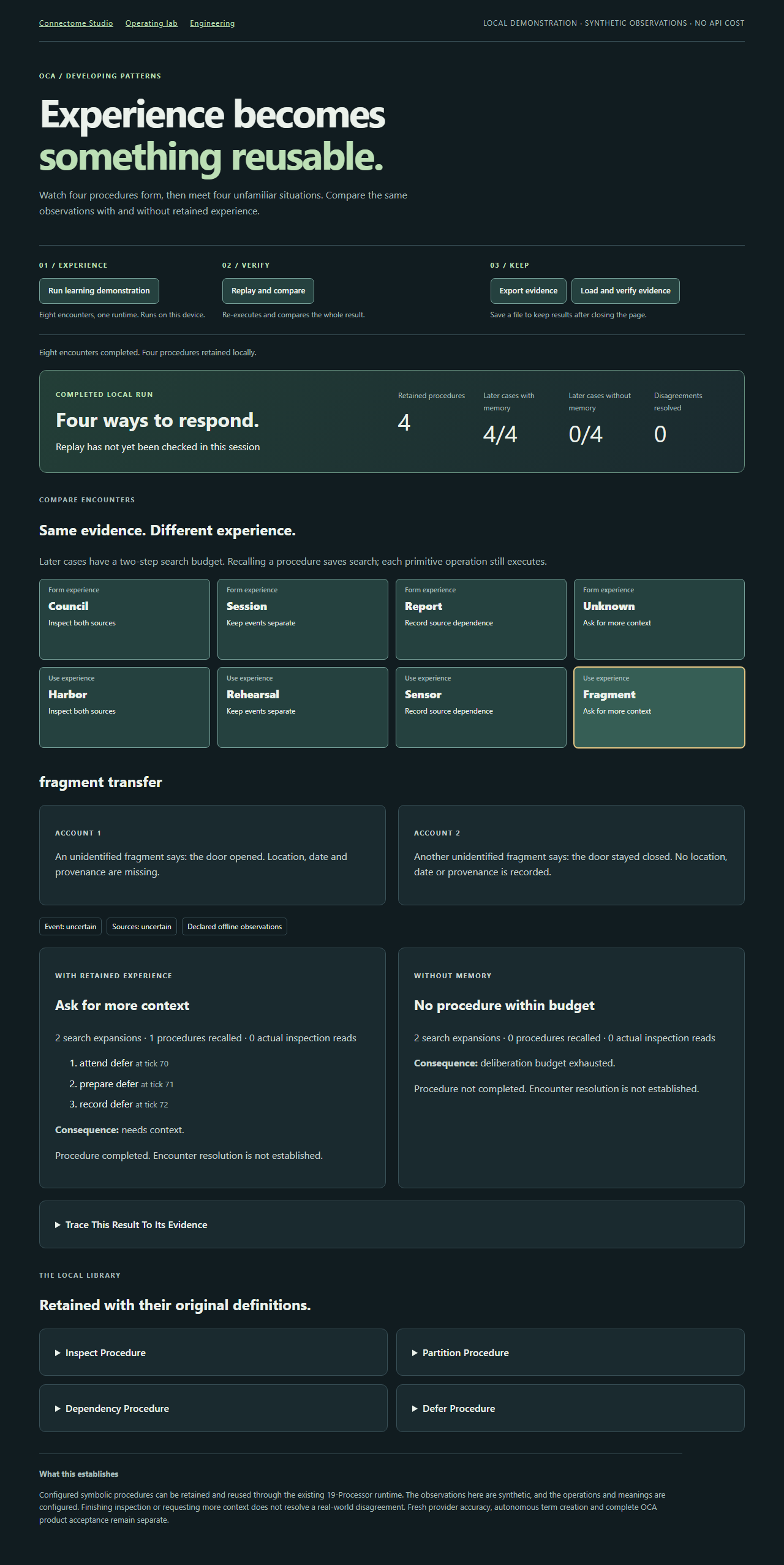
Opening detail of a local synthetic comparison showing retained procedures beside the no-memory condition. Retained October 2026 capture; it reports replay not yet checked in that session. These are computational results, not human learning measures.
Open full capture ↗A closer look · Recorded mechanism
This explainer follows an OCA rule-refinement record. It makes one small mechanism visible within the larger programme. It is a reconstruction of recorded stages, not a live agent run.
A useful shortcut, with a missing condition
The initial action rule requests inspection when accounts concern the same event. It does not yet require those accounts to be independent.
event=same_eventA dependent-account case exposes an unsupported inspection request.
A continuing relationship needs a way to be wrong and change. Here that idea becomes a retained rule revision. Whether a person understands, trusts or benefits from that revision is a separate research question.
What the work has taught us
Retained procedures improved a bounded agent task. Human understanding, joint success and appropriate reliance still need separate observation.
The 11-encounter record →In three semantic-evaluation scenarios, outcomes were unchanged while the evaluator used extra reads. Inspection needs a purpose.
The equal-outcome result →Recovery can retain identity and history without establishing meaningful continuity for a person—or completing a different system’s lifecycle.
Three distinct continuity cases →The wider intellectual landscape
The public essays trace questions about experience, human potential, qualitative reflection and the authority of measurement. Some extend into speculative field and consciousness accounts. They are authored propositions, with evidentiary requirements distinct from software demonstrations.
This portfolio draws those strands into a research programme; it does not claim to exhaust the entire development archive.
A research programme in motion
Explore the designs, examine the mechanisms, and keep the human question open.
Enter the evidence collection ↗The instruments behind the inquiry
Connectome construction and local execution, modeled access, RealityOS authoring and world inspection give the research concrete mechanisms to examine.
Powered by
The connected explorer runs on RealityOS. AMIA supplies the wider platform context; OCA is presented through recorded demonstrations in this edition.
 RealityOS
 AMIA
 OCA